
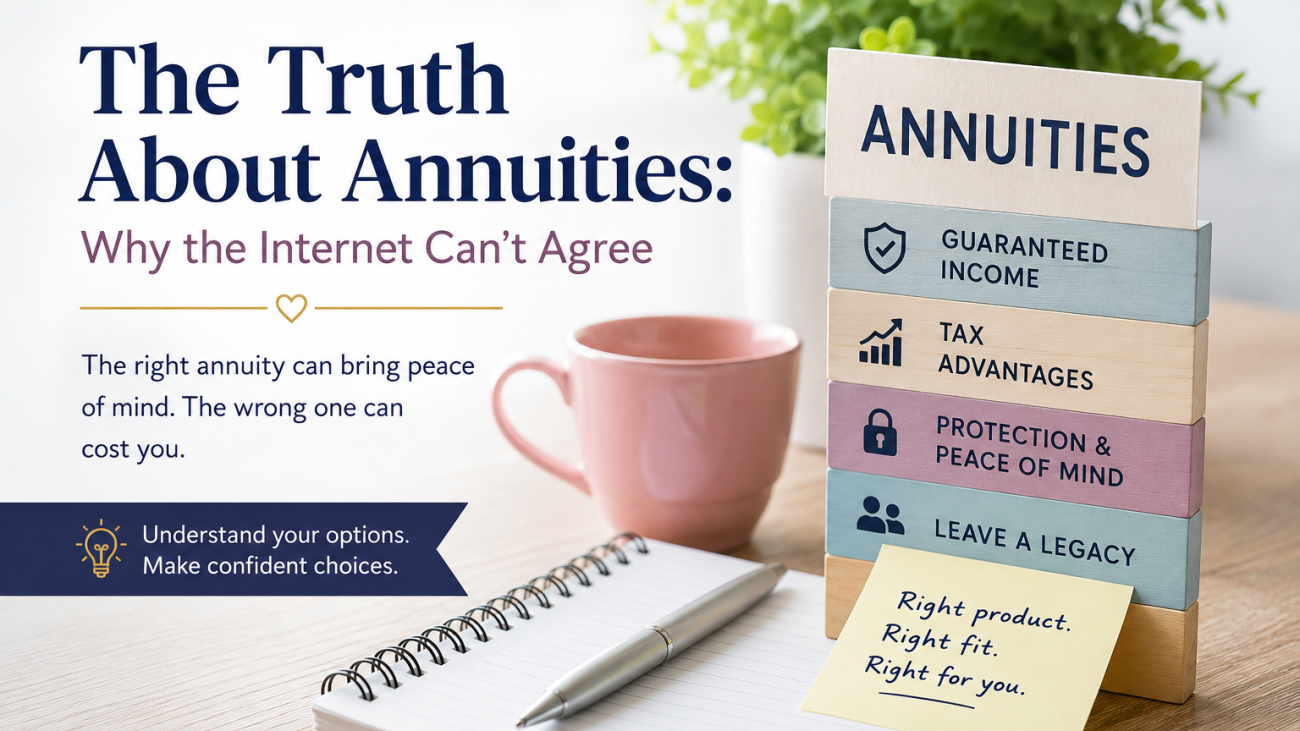
I recently came across a question in a women’s financial group that perfectly captures why so many people are confused about annuities.
A woman asked a simple question: “A gentleman wants me to invest in an annuity. It sounds too good to be true. What do you think?”
The responses came flooding in.
“Run away.”
“My annuity saved my retirement.”
“They’re terrible.”
“They’re wonderful.”
“They have high fees.”
“They’ve given my mom guaranteed income for years.”
“The salesperson earns too much.”
“They’re perfect if you’re conservative.”
“They’re a scam.”
Reading through the comments, I realized something. No one was really talking about annuities. They were talking about their annuity.
There Isn’t Just One Type of Annuity
Imagine asking: “Should I buy a car?” Would anyone be able to answer? Of course not.
- Do you need a pickup truck?
- A hybrid?
- A sports car?
- A minivan?
Annuities are exactly the same. There isn’t one annuity. There are dozens of different products with different purposes. Some are designed to:
- Protect your principal.
- Generate guaranteed lifetime income.
- Participate in market growth.
- Leave money to your beneficiaries.
- Reduce longevity risk.
Others may have features you don’t need—or fees you shouldn’t pay. The question isn’t whether annuities are good or bad. The question is whether this annuity is appropriate for your situation.
Why Opinions Are So Polarized
Many people have strong feelings about annuities because they’ve only experienced one. Someone who purchased a high-fee variable annuity 20 years ago may tell everyone to avoid annuities forever. Someone whose guaranteed lifetime income allowed them to stay in their home after their spouse died may believe annuities are the best financial product ever created. Both experiences are real. Neither tells the whole story.
The Better Questions to Ask
Instead of asking, “Should I buy an annuity?” ask:
- What problem is this annuity solving?
- What happens if I never buy it?
- What are the fees?
- How does the advisor get paid?
- What guarantees are backed by the insurance company?
- What happens if I need my money early?
- What happens when I die?
- How does this fit with my Social Security, investments, and other retirement income?
Those questions matter far more than whether someone on the internet loves—or hates—annuities.
Here’s What I Believe
I’ve seen annuities dramatically improve retirement plans. I’ve also seen annuities that never should have been sold. I’ve seen widows who slept better because they knew another paycheck would arrive every month. I’ve also met retirees who paid for features they neither needed nor understood. The difference wasn’t the product. It was the planning.
The Bottom Line
An annuity is a tool. Like any financial tool, it can be incredibly valuable when used appropriately. Or it can be completely unnecessary. The goal shouldn’t be to buy—or avoid—annuities. The goal should be to build a retirement income plan that gives you confidence. Sometimes an annuity belongs in that plan. Sometimes it doesn’t.
The right answer isn’t found in a Facebook comment. It’s found by understanding your goals, your income needs, your risk tolerance, and how every piece of your retirement puzzle fits together.
That’s why the question isn’t: “Should I buy an annuity?” The better question is: “Is this annuity right for me?”
To learn more, download a copy of Her Guide to Annuities here.