ChatGPT Image Jul 10, 2026, 10_50_34 AM

Eliminating the Fear Factor of Retirement

“People experience retirement emotionally before they experience it mathematically.”

That may be one of the smartest things I’ve read about retirement planning. It immediately reminded me of the television show Fear Factor. Remember it? Contestants willingly jumped from helicopters, crawled through confined spaces, balanced high above the ground, and ate things most of us wouldn’t go near. The premise was simple: fear changes behavior. Sometimes it causes us to freeze. Sometimes it causes us to overreact. Sometimes it convinces us to avoid something altogether. And sometimes it makes us do things we would never choose if we felt calm, safe, and in control.

Retirement has its own version of Fear Factor. Only instead of spiders, snakes, and impossible stunts, the fears sound like this: Will I have enough? Can I really stop working? What if the market crashes? What if healthcare costs wipe me out? What if I become a burden to my children? What if I make the wrong decision and can’t recover?

Those aren’t simply mathematical questions. They are emotional questions. And until those fears are acknowledged and addressed, it can be very difficult to make confident financial decisions.

Why Retirement Feels So Emotional

Retirement represents one of the biggest transitions most people will ever make.

For decades, you receive a paycheck. You know when it will arrive. You know roughly how much it will be. You build your life around that rhythm. Then retirement asks you to turn accumulated savings into income and trust that the money will last for the rest of your life. This is a major psychological shift.

Even people with substantial savings can struggle with it. A retirement account balance may look reassuring on paper, but spending from it can feel very different. Every withdrawal can feel like a permanent reduction. Every market decline can feel like a threat. Every unexpected expense can raise the question: What if this is the beginning of running out?

This is why many retirees become overly cautious, even when they can afford to spend more. They postpone trips, avoid helping family, and deny themselves experiences they spent decades saving for.

The fear of running out can become so powerful that people never fully enjoy the money they worked so hard to accumulate.

The Science of Fear and Financial Decision-Making

Our brains are designed to protect us from danger.

Thousands of years ago, fear helped humans survive immediate threats. Today, the same biological response can be triggered by a falling account balance, a frightening news headline, or uncertainty about future expenses.

When fear takes over, long-term thinking becomes harder. We tend to focus on avoiding immediate pain rather than making the best decision for the future.

Behavioral finance has shown that people generally feel the pain of a loss more intensely than the pleasure of an equivalent gain. Losing $10,000 often feels much worse than gaining $10,000 feels good. This emotional imbalance can influence retirement decisions in powerful ways.

Fear may cause someone to sell investments after the market has already fallen, locking in losses. It may lead someone to keep too much money in cash for years, reducing growth and purchasing power. It may cause a person to delay retirement even when the numbers show they are financially prepared. It may also lead to endless second-guessing, constant account checking, and an inability to enjoy retirement.

Ironically, one of the greatest risks to a retirement plan may not be market volatility itself. It may be the decisions fear causes us to make.

Retirement Planning Should Address Both Math AND Emotion

Traditional retirement planning often focuses on projections, rates of return, withdrawal strategies, and probability-of-success calculations. Those tools are important. But they do not automatically create peace of mind. A plan can work beautifully on paper and still leave someone terrified to spend. That is why retirement planning should answer two questions:

  1. Will the money work?
  2. Will the plan help you feel secure enough to live?

A strong retirement plan should do both.

Introducing the Confidence Foundation™

At Her Retirement, I believe every retirement plan should begin by building what I call a Confidence Foundation™. Think of it as the financial base that helps you sleep well at night. The purpose of the Confidence Foundation™ is to provide dependable income for the expenses you simply cannot avoid.

Ask yourself this question: If the stock market dropped 30% tomorrow, would I still be able to pay my essential monthly expenses? If the answer is yes, you have reduced one of retirement’s biggest emotional risks.

Your essential expenses may include housing, food, healthcare, insurance, utilities, taxes, and basic transportation. These are the costs that continue regardless of what the market does. The goal is to match as much of those expenses as reasonably possible with income sources that are reliable, predictable, or guaranteed.

What Can Make Up a Confidence Foundation™?

There is no single product or strategy that works for everyone. The right combination depends on your income needs, assets, health, risk tolerance, tax situation, and goals.

For many people, Social Security forms the first layer. Because it provides inflation-adjusted lifetime income, it can be one of the most valuable components of a retirement income plan. The decision about when to claim can have a lasting impact, which is why it deserves careful consideration.

A pension may provide another dependable monthly income stream. Some retirees may also choose an annuity to create guaranteed lifetime income that helps fill the gap between Social Security, pension income, and essential expenses.

For others, a bond ladder, Treasury ladder, or CD ladder may provide predictable cash flow over a defined period. Cash reserves can also play an important role by covering near-term spending needs and reducing the chance that investments must be sold during a market downturn. Some people may use several of these strategies together.

The important point is this: the Confidence Foundation™ is not one product. It is a planning outcome. Its job is to make sure the money needed for basic living expenses is not completely dependent on short-term market performance.

Where Annuities May Fit

Annuities can be useful for some retirees because they can convert a portion of savings into a predictable income stream that lasts for life. This can be especially valuable for someone who does not have a pension, is concerned about outliving her money, or wants more certainty around essential expenses.

But annuities are not all the same, and they are not appropriate for everyone. Fees, liquidity, guarantees, riders, surrender periods, and the strength of the issuing insurance company all matter.

The question should never be: Do I need an annuity? A better question is: Do I have an income gap in my Confidence Foundation™, and what is the most appropriate way to fill it?

An annuity may be one possible answer. It should not be the automatic answer, or the answer that an insurance salesperson pushes on you.

Building Your Freedom Fund™

Once your Confidence Foundation™ is in place, the rest of your assets have a different job. I call this your Freedom Fund™.

The Freedom Fund™ is designed to help you enjoy retirement, maintain flexibility, keep pace with inflation, and support the life you want to create. It may include stock mutual funds, ETFs, individual stocks, Roth IRAs, traditional IRAs, 401(k)s, brokerage accounts, real estate, or other long-term growth assets.

Because essential expenses are already being addressed through the Confidence Foundation™, the Freedom Fund™ does not have to carry the full emotional burden of paying next month’s bills. This can make market volatility feel less threatening.

Instead of viewing a market decline as a threat to your ability to buy groceries, you may be able to view it as a temporary fluctuation in assets intended for long-term growth and discretionary goals.

The Freedom Fund™ can support travel, hobbies, family experiences, charitable giving, home improvements, education, starting a business, or simply enjoying more of the life you worked so hard to build.

Why the Two-Part Strategy Can Work Emotionally

The power of the Confidence Foundation™ and Freedom Fund™ is not only financial. It’s emotional.

When the basics are protected, retirees may feel more comfortable leaving growth assets invested. They may be less likely to panic during market declines. They may also feel more confident spending on the things that bring joy and meaning to retirement.

This structure creates clarity. One part of the plan is designed for security. The other is designed for growth, flexibility, and possibility. This separation can reduce the feeling that every dollar must perform perfectly at all times.

Confidence Changes Behavior

When every dollar in your portfolio has to perform perfectly just to pay the electric bill, every market headline feels personal. But when your Confidence Foundation™ covers your essential lifestyle, something shifts. Fear begins to loosen its grip. You make calmer decisions. You stay invested more consistently. You become more comfortable spending. You stop treating every market decline as an emergency.

Most importantly, you may begin to experience retirement as a life to be lived rather than a financial problem to be managed. The goal is not simply to maximize returns. The goal is to maximize confidence.

At Her Retirement, we believe retirement planning is about far more than spreadsheets, rates of return, and investment performance.

We help women make informed financial decisions so they can retire with confidence and create a life of meaning. Because the best retirement plan is not necessarily the one with the highest projected return. It’s the one that helps you feel secure enough to live the life you planned for.

If you’d like some guidance on creating a life (and a retirement) with confidence and freedom, reach oout. We can help you Get Her Done.
ChatGPT Image Jun 27, 2026, 11_32_34 PM

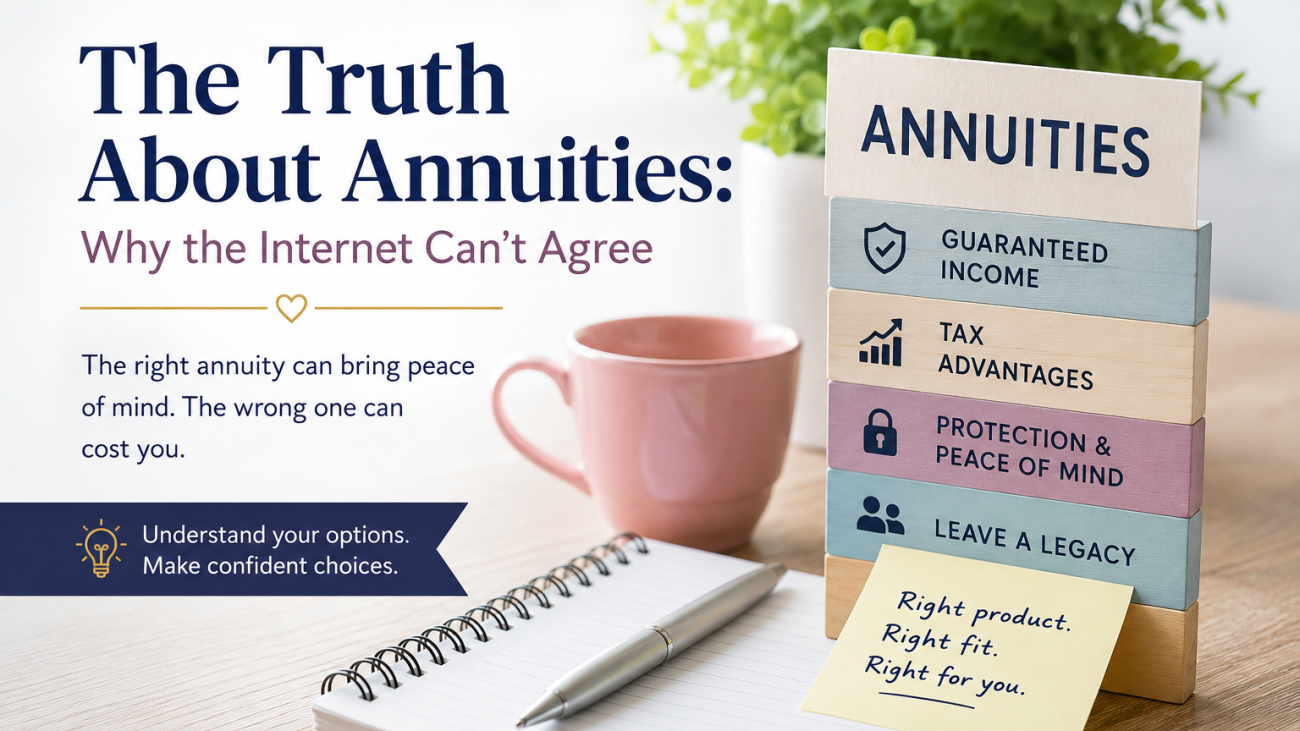
Why You’ll Never Get a Straight Answer About Annuities

I recently came across a question in a women’s financial group that perfectly captures why so many people are confused about annuities.

A woman asked a simple question: “A gentleman wants me to invest in an annuity. It sounds too good to be true. What do you think?”

The responses came flooding in.

“Run away.”

“My annuity saved my retirement.”

“They’re terrible.”

“They’re wonderful.”

“They have high fees.”

“They’ve given my mom guaranteed income for years.”

“The salesperson earns too much.”

“They’re perfect if you’re conservative.”

“They’re a scam.”

Reading through the comments, I realized something. No one was really talking about annuities. They were talking about their annuity.

There Isn’t Just One Type of Annuity

Imagine asking: “Should I buy a car?” Would anyone be able to answer? Of course not.

  • Do you need a pickup truck?
  • A hybrid?
  • A sports car?
  • A minivan?

Annuities are exactly the same. There isn’t one annuity. There are dozens of different products with different purposes. Some are designed to:

  • Protect your principal.
  • Generate guaranteed lifetime income.
  • Participate in market growth.
  • Leave money to your beneficiaries.
  • Reduce longevity risk.

Others may have features you don’t need—or fees you shouldn’t pay. The question isn’t whether annuities are good or bad. The question is whether this annuity is appropriate for your situation.

Why Opinions Are So Polarized

Many people have strong feelings about annuities because they’ve only experienced one. Someone who purchased a high-fee variable annuity 20 years ago may tell everyone to avoid annuities forever. Someone whose guaranteed lifetime income allowed them to stay in their home after their spouse died may believe annuities are the best financial product ever created. Both experiences are real. Neither tells the whole story.

The Better Questions to Ask

Instead of asking, “Should I buy an annuity?” ask:

  • What problem is this annuity solving?
  • What happens if I never buy it?
  • What are the fees?
  • How does the advisor get paid?
  • What guarantees are backed by the insurance company?
  • What happens if I need my money early?
  • What happens when I die?
  • How does this fit with my Social Security, investments, and other retirement income?

Those questions matter far more than whether someone on the internet loves—or hates—annuities.

Here’s What I Believe

I’ve seen annuities dramatically improve retirement plans. I’ve also seen annuities that never should have been sold. I’ve seen widows who slept better because they knew another paycheck would arrive every month. I’ve also met retirees who paid for features they neither needed nor understood. The difference wasn’t the product. It was the planning.

The Bottom Line

An annuity is a tool. Like any financial tool, it can be incredibly valuable when used appropriately. Or it can be completely unnecessary. The goal shouldn’t be to buy—or avoid—annuities. The goal should be to build a retirement income plan that gives you confidence. Sometimes an annuity belongs in that plan. Sometimes it doesn’t.

The right answer isn’t found in a Facebook comment. It’s found by understanding your goals, your income needs, your risk tolerance, and how every piece of your retirement puzzle fits together.

That’s why the question isn’t: “Should I buy an annuity?” The better question is: “Is this annuity right for me?”

To learn more, download a copy of Her Guide to Annuities here.

Untitled design (16)

The Purposeful Portfolio™: The Cornerstone of a Confident Retirement

For years, retirement planning has been framed as a quest for the perfect portfolio. The ideal asset allocation. The optimal withdrawal rate. The precise mix of stocks, bonds, and alternatives that will mathematically guarantee success.

But in my experience, perfection has never been the real driver of retirement confidence.

Purpose has.

Women don’t lose confidence in retirement because their portfolios are slightly sub-optimal. They lose confidence when their money doesn’t reflect how they actually live, what they value, or what they’re trying to protect. A portfolio can be technically sound and still fail if it doesn’t feel right to the person holding it.

Research shows that women tend to be less focused on relative portfolio performance and more focused on outcomes, whether their money will support their life, protect them from major setbacks, and align with what matters most to them.

Interestingly, this way of thinking is beginning to surface more broadly across the retirement industry. Recent commentary from Christine Benz, Director of Personal Finance and Retirement Planning at Morningstar, who was awarded the inaugural Realie Award for her blog on the value of a “good enough” portfolio echoes something I’ve believed for a long time: most people don’t need perfect portfolios. They need portfolios they can live with, and stick with.

That conviction and lots of research over the last ten years, is what led me to create Her Purposeful Portfolio™—a framework designed specifically for women who want their money to support not just longevity, but meaning, flexibility, and peace of mind.

The Problem With Chasing the “Perfect” Retirement Portfolio

Traditional retirement advice often assumes that better outcomes come from better math. More precision. More fine-tuning. More comparisons.

In reality, that approach often leads to:

  • Analysis paralysis
  • Ongoing second-guessing
  • Emotional decision-making during market stress
  • Plans that look great on paper but fall apart in real life

Christine Benz describes two common investor mindsets: maximizers, who endlessly seek the best possible option, and satisficers, who aim for a solution that is good enough to meet their goals.

Her insight is critical for retirees: the incremental gains from optimization are often outweighed by the stress, time, and behavioral mistakes that come with it.

In other words, a portfolio you can stick with often outperforms the one you abandon.

This idea often gets confused with the familiar saying “time in the market beats timing the market,” but it’s slightly different. Timing the market assumes people fail because they misjudge markets. Abandoning portfolios happens because people misjudge themselves. A plan can be mathematically sound and still fail if it doesn’t align with how someone actually experiences risk, uncertainty, and change. Time in the market only works if the portfolio fits the person holding it.


From “Good Enough” to Purposeful

A “good enough” portfolio is a powerful starting point.
A purposeful portfolio is what makes it sustainable.

The Purposeful Portfolio™ shifts the question from..
“What allocation is optimal?”
to
“What is my money meant to do for me?”

Traditional bucket strategies organize money by time horizon. The Purposeful Portfolio™ builds on that idea by organizing money around purpose, and how each piece is meant to feel.

Instead of organizing retirement assets solely by risk and return, the Purposeful Portfolio™ organizes money by function and feeling, because behavior, confidence, and clarity matter just as much as performance.


The Five Pillars of Her Purposeful Portfolio™

1. Security (SecureHER)

What it’s for:
Covering essentials and protecting the rest of the portfolio. This pillar is designed to fund non-negotiables like housing, food, insurance, and basic living expenses while also buffering against market volatility and sequence-of-returns risk, especially in the early years of retirement.

How it feels:
Calm. Reliable. Reassuring. Grounded.

Common tools:
FDIC-insured cash, high-yield savings accounts (HYSAs), money market funds, short-term bonds, T-Bills, and for some women, protected strategies such as fixed or fixed indexed annuities.

In retirement, cash held in an HYSA isn’t just an emergency fund, it becomes part of a Stability strategy that provides liquidity, smooths income, and reduces the need to sell long-term investments during market downturns.

For women who want additional protection, certain fixed or fixed indexed annuities can also play a role in this pillar. These strategies are often used as bond alternatives, offering principal protection with the potential for more upside than traditional bonds, and are frequently designed to create future income later in retirement, rather than immediately.

This pillar exists so the rest of the portfolio doesn’t have to carry emotional or timing risk. When essentials are protected and income pressure is reduced, long-term investments are given the space they need to do their job.

2. Flexibility (LiveHER)

What it’s for:
Travel, hobbies, experiences, spontaneity, and joy.

How it feels:
Free. Ready. Guilt-free.

Common tools:
Balanced funds, laddered CDs, dividend-focused ETFs.

Flexibility is often missing from traditional plans, especially for women who feel hesitant to spend. This pillar gives permission.

3. Wellness (HealthiHER)

What it’s for:
Healthcare, longevity risk, caregiving, and life’s “what-ifs.”

How it feels:
Protective. Grounded. Peace of mind.

Common tools:
HSAs, long-term care planning, health-focused assets.

This pillar acknowledges a reality many plans ignore: health is both a financial and emotional issue in retirement.

4. Growth (FutureHER)

What it’s for:
Long-term security, inflation protection, and future purchasing power.

How it feels:
Empowered. Energized. Strategic.

Common tools:
Equities, diversified index funds, REITs.

Growth doesn’t disappear in retirement, it just becomes more intentional.

5. Legacy (ImpactHER)

What it’s for:
Who—and what—you want to leave behind.

How it feels:
Intentional. Values-based. Enduring.

Common tools:
Trusts, beneficiary planning, donor-advised funds, ESG-aligned strategies.

Legacy isn’t just about inheritance. It’s about meaning.


Why This Framework Matters, Especially for Women?

Women tend to:

  • Live longer
  • Earn less over their lifetimes
  • Take on more caregiving responsibilities
  • Retire alone more often due to divorce or widowhood

The old rules of retirement planning were not built with these realities in mind.

The Purposeful Portfolio™ recognizes that retirement success is not just about accumulation, it’s about confidence, continuity, and clarity. It creates structure without rigidity and flexibility without chaos.


Where Her Retirement PersonaTM Fits In?

One reason a “good enough” portfolio works for some people—and fails for others—comes down to behavior.

At Her Retirement, we use the Her Retirement Persona™ framework to identify the patterns that shape how a woman thinks about money, risk, freedom, security and her retirement life. It’s not about labels. It’s about understanding how she makes decisions so her portfolio works with her instincts instead of against them.

For example:

  • A Security Seeker naturally emphasizes stability, predictability, and wellness planning.
  • An Adventurer tends to weight flexibility and growth more heavily to support experiences and freedom.
  • A Giver often prioritizes legacy, protection for loved ones, and impact beyond herself.

There is no single correct mix, only the mix that aligns with who she is and how she wants to live. When portfolio design reflects personality, confidence rises and second-guessing fades.

This is where purpose replaces perfection—and where personality comes before portfolio design.


The Real Goal: A Portfolio That Supports Your Life

Christine Benz’s work reminds us that retirement planning doesn’t need to be flawless to be effective. In fact, striving for flawlessness often undermines confidence.

Her Retirement’s concept of the Purposeful Portfolio™ builds on that insight by giving retirees a framework that is:

  • Understandable
  • Adaptable
  • Behaviorally realistic
  • Aligned with real life

Not perfect.
Not optimized to death.
But intentional, personal, and strong enough to support a long life well lived.

That’s what a good enough portfolio looks like…when it’s built with purpose.


A Purposeful Next Step

If you’re a woman who wants to build a portfolio that reflects who you are, not just what the market expects, one that balances protection, flexibility, growth, wellness, and impact, you don’t have to figure it out alone. We can help connect you with a retirement planner who understands purposeful, behavior-aligned planning for women.

If you’re a financial advisor who wants to build better, more meaningful portfolios for women (portfolios that account for personality, longevity, lifestyle, and real-life decision-making), we invite you to reach out to learn more about the Her Retirement Purposeful Portfolio™ and Retirement Persona™ framework.

Because retirement planning works best when it’s not just technically sound, but personally aligned.

Reach out to me, Lynn Toomey, founder and creator of Her Retirement and Her Purposeful Portfolio at: lynnt@herretirement.com.


Sources & Research

This article is informed by ongoing research and industry studies on women, investing behavior, and retirement confidence, including:

  • Fidelity Investments, Women & Investing Studies (various years)

  • UBS Global Wealth Management, Investor Watch reports

  • Vanguard, research on investor behavior and long-term outcomes

  • Global Financial Literacy Excellence Center (GFLEC), research on financial confidence and behavior

  • Morningstar research on retirement planning, investor behavior, and sustainable portfolio design


What is an Annuity & Why Should I Consider Them for My Retirement Plan?

Annuities can be a valuable component of your retirement plan and income during your retirement…depending upon your goals and objectives. Like all strategies we review here in our blog, we strive to provide objective, independent and truthful information.

What is an annuity and how can it benefit you? Annuity contracts are purchased from an insurance company. The insurance company will then make regular payments — either immediately or at some date in the future. These payments can be made monthly, quarterly, annually, or as a single lump-sum. Annuity contract holders can opt to receive payments for the rest of their lives or for a set number of years. The money invested in an annuity grows tax-deferred. When the money is withdrawn, the amount contributed to the annuity will not be taxed, but earnings will be taxed as regular income. There is no contribution limit for an annuity.

There are two main types of annuities:

  • Fixed annuities offer a guaranteed payout, usually a set dollar amount or a set percentage of the assets in the annuity.
  • Variable annuities offer the possibility to allocate premiums between various subaccounts. This gives annuity owners the ability to participate in the potentially higher returns these subaccounts have to offer. It also means that the annuity account may fluctuate in value. Indexed annuities are specialized variable annuities. During the accumulation period, the rate of return is based on an index.

Watch this video to learn more about Indexed Annuities and how they can help your retirement plan.

Case Study: Robert’s Fixed Annuity

  • Robert is a 52-year-old business owner. He uses $100,000 to purchase a deferred fixed annuity contract with a 4% guaranteed return.
  • Over the next 15 years, the contract will accumulate tax deferred. By the time Robert is ready to retire, the contract should be worth just over $180,000.
  • At that point the contract will begin making annual payments of $13,250. Only $7,358 of each payment will be taxable; the rest will be considered a return of principal.
  • These payments will last the rest of Robert’s life. Assuming he lives to age 85, he’ll eventually receive over $265,000 in payments.

Robert’s annuity may have contract limitations, fees, and charges, including account and administrative fees, underlying investment management fees, mortality and expense fees, and charges for optional benefits. His annuity also may have surrender fees that would be highest if Robert took out the money in the initial years of the annuity contact. Robert’s withdrawals and income payments are taxed as ordinary income. If he makes a withdrawal prior to age 59½, a 10% federal income tax penalty may apply (unless an exception applies).

If you’d like to chat with an affiliated advisor about annuities and incorporating them into your retirement plan, let us know by requesting a 1-on-1 discussion. We’re happy to help.